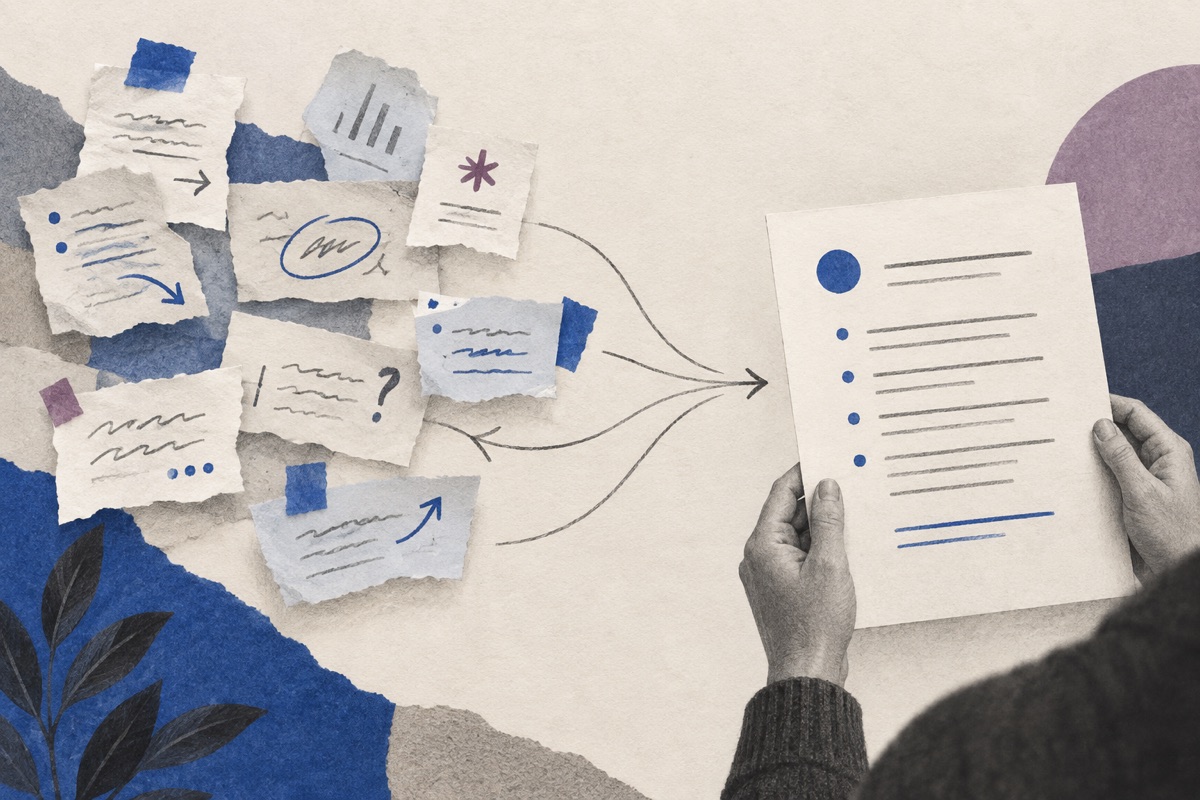
Reading a long AI answer can leave you with a collection of reactions: one sentence you agree with, two questions, a missing constraint, and a recommendation you want challenged. The hard part is turning those fragments into a prompt that still makes sense outside your head.
A contextual Follow-up Prompt does not summarize your feedback. It organizes each Thought beside the Source that produced it, then gives the assistant a clear contract for responding.
Why a list of comments is not enough
Copied into a blank message, comments such as “Why?”, “Keep this,” and “What about rollback?” have no stable meaning. You know what they refer to because you just read the answer. The assistant sees only fragments.
Rewriting the comments into a polished summary can also remove useful specificity. The phrase you chose may contain a technical constraint or a degree of uncertainty that a summary softens.
Build the prompt from Source–Thought pairs
For every Comment or Reaction, include the relevant Source first. Then preserve the Thought exactly. This gives the assistant both evidence and instruction.
Order the pairs as they appeared in the original answer. That sequence exposes cause and effect: an early assumption may explain why you challenged a later recommendation.
- Start with a short response contract.
- Quote the Source passage without rewriting it.
- Name the Reaction when one exists.
- Preserve every Comment exactly as written.
- Keep sections in document order and avoid duplicate instructions.
Tell the assistant how to handle different signals
Positive and actionable feedback should not be treated the same way. Love and Agree show what the assistant should preserve. Challenge, Explain, and Concern require a response. Comments may contain questions, assumptions, or requested changes.
A good response contract says this explicitly. It asks the assistant to address questions and risks point by point, keep accepted material, verify assumptions inside Comments, and update the overall recommendation when necessary.
Use the follow-up as a learning checkpoint
The final prompt is not merely a productivity shortcut. It records what changed while you read. The assistant's next answer can now meet you at the edge of your understanding instead of repeating the original explanation.
This matters when AI accelerates you into unfamiliar territory. The prompt becomes a checkpoint between receiving information and acting on it.
- Does every Comment still have enough Source context?
- Are accepted ideas clearly preserved?
- Are questions answerable rather than rhetorical?
- Are risk statements paired with a requested next step?
- Would another person understand the prompt without seeing your notes?
Do not ask the next prompt to reconstruct your thinking. Carry the Sources, Reactions, and exact Comments with you, in order, as one coherent request.